
In 2024, 1,032 construction and extraction workers died on the job.
You already know summer changes the job. The heat sits on you by nine in the morning. The pace doesn’t slow down for it. Equipment runs longer, crews rush to beat weather, and everyone is a little more tired by three in the afternoon than they were in March. None of that is new to you. What’s worth knowing is how often that combination kills people, and how many of those deaths trace back to something that should have been fixed before you ever climbed the ladder or stepped into the trench.
Construction workers make up a small slice of the American workforce and account for roughly one in five workplace deaths. Four hazards, what OSHA calls the “Fatal Four,” are responsible for close to 60 percent of those deaths. If you work construction, you are not statistically unlucky if one of these touches your life. You are the expected outcome of a system that still lets preventable hazards slide.
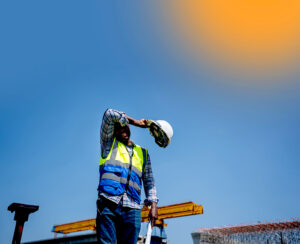
Heat: The One Nobody Fixed Yet
There is still no federal law requiring your employer to protect you from heat. OSHA proposed one in August 2024. Hearings dragged through the summer of 2025; the comment period closed that October, and the rule has sat untouched since, with no finalization date and no urgency behind it from the current administration. If you are waiting on Washington to force water breaks onto your job site, you could be waiting a long time.
Heat-related illness is the leading cause of weather-related death among American workers, and it moves faster than most people expect. It starts small: heat rash, a cramp in your calf or your forearm, a headache you write off as dehydration from the night before. Left alone, it progresses to heat exhaustion, heavy sweating, dizziness, nausea, a racing pulse, and from there to heat stroke, where your body stops sweating altogether, and your core temperature climbs past the point your organs can tolerate. Heat stroke can kill within the same shift it starts. Rhabdomyolysis, a breakdown of muscle tissue that floods your kidneys with toxins, is common enough among heat-stressed manual laborers that OSHA now requires employers to report it as a heat-related hospitalization. None of this requires a heat wave. An 88-degree day with high humidity in the Southeast can feel like well over 100, and heavy PPE, hard hats, harnesses, long sleeves for cut protection, traps that heat against your skin and make every one of these stages arrive faster.
New workers and anyone returning from time off are at the highest risk because the body needs one to two weeks of graduated exposure to build tolerance to heat. A crew that throws a new hire straight into a full day of concrete or roofing work in July, with no acclimatization period, is setting that person up for exactly the kind of collapse OSHA’s guidance exists to prevent.
What exists instead of a federal standard is enforcement built on a patchwork. OSHA runs a Heat National Emphasis Program, renewed in April 2026 through 2031, that lets inspectors treat any site visit as a heat inspection if they see the signs: no water, no shade, a heat-related injury on the books. On days the heat index hits 80°F or the National Weather Service issues an advisory, that scrutiny goes up automatically. Short of a hard rule, OSHA still cites employers under the General Duty Clause when a heat hazard is obvious and nothing is done about it, and it has issued roughly 60 such citations since 2022 alongside 7,000 heat-related inspections. Nearly all inspected employers already had water and shade on site. If yours didn’t, that absence is not an oversight. It is a choice someone made, and it is the kind of choice that shows up later in a heat stroke, a collapse, or worse.
If you work in California, Nevada, Maryland, Oregon, Washington, Colorado, or Minnesota, your state already has its own heat law with real teeth, regardless of what happens federally. Know which rules apply to your job site.
Daily Injury Concerns
Heat is not the only thing that can end your day early. Falls, struck-by incidents, being caught in or between equipment, and electrocution round out what OSHA calls the “Fatal Four,” and together they account for close to 60 percent of construction deaths in a given year, heat wave or not. These are the hazards that are there every day you’re on site, in July and in November alike.
Falls: The Hazard That Kills the Most
Falls kill more construction workers than anything else on this list, roughly a third of all Fatal Four deaths. In 2024, 844 workers nationwide died from falls, slips, and trips, and about 11 percent of those falls were from more than 30 feet up. If you’ve ever worked on a roof, a scaffold, or steel without a harness clipped in, without a guardrail where one should have been, you already know how close that number can feel.
Federal law requires fall protection, guardrails, nets, or a harness system, anytime you’re exposed to a fall of six feet or more. It requires a trained “competent person” on site who is supposed to catch unsafe conditions before you’re the one who finds them the hard way. When that person doesn’t show up, when the harness was in the truck instead of on your body, when the scaffold went up without proper planking because the job was behind schedule, that is not bad luck. That is a decision your employer or a contractor made about your life, usually to save time or money.
Struck-By: Hurt by Something You Never Saw Coming
About 11 percent of construction deaths are struck-by incidents, and the cruel part is that the worker who gets hit is often nowhere near the task that caused it. A tool dropped three stories down. A load that swings wrong during a crane lift. A truck backing up with no spotter watching for you. You can do everything right and still end up in this statistic because someone else’s carelessness became your injury.
Cranes are supposed to have trained signal persons and clear exclusion zones. Forklifts and other powered equipment are supposed to be operated by people trained to do it. Tools at height are supposed to be tethered. When those basics get skipped, the risk doesn’t disappear. It just gets transferred to whoever happens to be standing underneath.
Caught-In or Caught-Between: The Trench That Should Have Been Shored
Roughly 5 to 6 percent of construction deaths come from being crushed, pinned, or caught between equipment, materials, or a collapsing structure, and trench collapses are the clearest, most preventable version of this. When OSHA cracked down hard on unprotected trenches, deaths fell from 39 in 2022 to 15 in 2023 and kept falling from there. That drop tells you something important: these deaths are almost entirely avoidable. A trench five feet deep or more is supposed to have a protective system, sloping, shoring, or shielding, and a daily check from someone qualified to catch trouble. If you were sent into a trench without that, someone skipped a step that exists specifically to keep you alive.
Electrocution: The Hazard That Doesn’t Warn You First
Electrocution accounts for roughly 8 to 9 percent of construction deaths, and it’s the one hazard on this list that gives you almost no chance to react. Contact with an overhead power line, a long tool near a live wire, wiring that should have had a ground fault circuit interrupter and didn’t, all of it can end a life in an instant with no warning beforehand.
You’re entitled to safe clearance from power lines, GFCIs on temporary wiring, and a locked-out, de-energized system before anyone works near it. When an electrocution happens, it is almost never a freak accident. It is almost always a safeguard that existed on paper and was skipped in practice.
What This Means If One of These Happened to You
Each hazard above has a rule attached to it, written specifically to protect you. When a company follows those rules, injuries still happen sometimes. But when a company cuts corners, skips an inspection, or decides a water break costs more than it’s worth, and you get hurt because of it, that injury has a cause and a name attached. The missing guardrail. The trench nobody shored. The water station that was never set up. The line that should have been dead and wasn’t.
Workers’ compensation will cover some of your medical bills and part of your lost wages. It will not make you whole, and it is very often not the only path available to you. If a subcontractor’s equipment hurt you, if a general contractor or property owner knew about a hazard and ignored it, or if a defective tool or machine failed you, you may have a claim outside the workers’ comp system entirely, one that accounts for what you actually lost: your health, your time, your ability to work, and everything the injury took from you and your family.
Workers’ Comp is not your only option.
If you or someone in your family was hurt on a construction site, contact Schwarz & Schwarz today for a free, no-obligation consultation: (215) 925-1200.
This blog post is provided for general informational purposes only and does not constitute legal advice. Every case is different — contact Schwarz & Schwarz to discuss the specific facts of your situation.